

How electrostatic ultrasonic sensing gives automated side loaders — and operator-assisted rear and front loaders — reliable distance data to support cleaner grabs, fewer collisions, and better-informed control and safety logic.
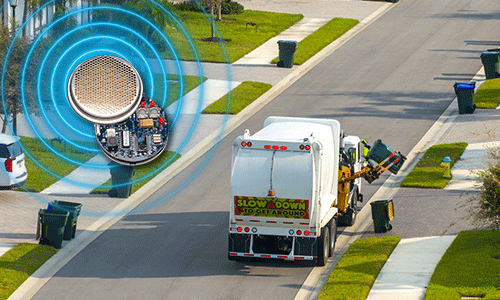
A modern residential collection route is one of the most demanding sensing environments in the heavy-equipment world. An automated side loader (ASL) pulls up to a curb, extends a robotic arm, finds a cart that may be tilted, half-buried in snow, parked too close to a mailbox, or sitting six inches from a parked car, lifts it twenty feet into the air, empties it, and sets it back down — then does it again, roughly 800 to 1,200 times a day, in rain, heat, dust, and cold, on a street shared with pedestrians, cyclists, and children.
Everything that makes that cycle fast also makes it unforgiving. A grab that misses by two inches doesn’t just waste a cycle — it can crush a cart against a vehicle, drop a loaded container onto the pavement, or, in the worst case, move an arm where a person is standing. The quality of the distance data feeding the arm’s control system is what separates a productive automated route from a costly one. This post looks at why cart pickup is a genuinely hard sensing problem, the four distinct ways a pickup can go wrong, and why SensComp’s electrostatic ultrasonic technology is well suited to feed that control system — for OEMs designing the truck and arm, and for the fleets that have to run them.
Why Cart Pickup Is Harder Than It Looks
From the cab, grabbing a cart looks trivial. Acoustically and mechanically, it is not. Four things work against a clean grab.
The targets are soft and inconsistent. A waste cart is molded plastic — often weathered, scuffed, and matte rather than smooth. It may scatter sound rather than returning a crisp echo the way a metal plate would. Worse, the thing the system most needs to not hit — a person, a pet, a fabric-covered stroller — is even softer and more acoustically absorptive. A sensor that can only resolve hard, cooperative surfaces may return little usable data on exactly the targets that matter most.
The geometry is never the same twice. Carts get set out tilted, overfilled with the lid propped open, nudged by wind, or jammed against obstacles. The arm has to locate and align to a target whose position varies cycle to cycle, often within inches of something it must avoid — a parked car, a utility pole, a hydrant, a second cart.
The environment is acoustically and thermally hostile. Routes run from sub-zero winter mornings to 100 °F-plus summer afternoons. The truck itself is a noise factory: hydraulic whine, air brakes, the diesel engine, the backup alarm, and the compactor all radiate energy — including ultrasonic energy — that can produce false readings with a conventional ultrasonic sensor. Add street noise, barking dogs, and other equipment, and you have an environment that actively generates false triggers.
Close range is where the action is. The final approach, the grab, and the set-down all happen within inches to a few feet of the arm — precisely the range where many ultrasonic sensors are weakest, because of a physical limitation called ring-out.
The Four Ways a Pickup Goes Wrong
A pickup isn’t a single requirement — it’s four, and a sensing solution has to feed good data into all of them.
- People near the truck. Collection happens on streets where people live. A child can step toward a cart the instant the arm reaches for it; a pedestrian can pass between the truck and the curb. The control system needs reliable distance data on soft, low-reflectivity human targets, at close range, to inform inhibit logic. This is the highest-stakes case and the hardest target to resolve. For fleets, this can be the difference between an avoidable close call and a cleaner, better-controlled pickup cycle; for OEMs, it’s the data quality your safety logic depends on.
- Cart and arm damage. A misjudged approach can crush a cart against a parked car, bend the gripper on an unseen obstacle, or drive the arm into a fixed object. Each event is a repair bill, a downtime hit, and a customer complaint. Accurate, repeatable distance data lets the control system bound the arm’s motion by what’s actually there.
- Mis-grabs and dropped carts. A grab that closes on empty air, on the lid instead of the body, or on a cart that’s slightly out of position can drop a loaded container into the street — a spill, a hazard, and a re-collection. Reliable target acquisition at the grab point is what separates a clean lift from a mess on the pavement.
- Collisions along the route. Between stops, the truck is a large vehicle maneuvering in tight residential space with constant blind spots. Longer-range obstacle data gives the system — or the operator — more time to slow smoothly rather than stop hard, easing wear and reducing the chance of contact. For fleets, that means fewer nuisance stops and less driveline wear; for OEMs, more margin in the deceleration logic.
A sensor that serves one or two of these but starves the others still leaves the system exposed. The case for electrostatic ultrasonic technology is that the same physical properties feed all four.
How Electrostatic Ultrasonic Sensor Technology Helps
SensComp’s electrostatic transducers differ from conventional piezoelectric sensors at the physical level, and those differences map directly onto the four cases above.
Sensitivity that resolves people and weathered carts, not just hard targets. Electrostatic ultrasonic transducers have approximately 40 dB greater receive sensitivity than comparable piezoelectric ultrasonic transducers, which recovers the faint, scattered echoes that come back from soft, absorptive surfaces. In practice, the SensComp sensor returns usable data from a person in a winter coat and from a scuffed, matte plastic cart, instead of losing the signal in noise. For the two cases that involve soft targets — people near the truck and clean cart acquisition — this is the foundational advantage.
Minimal ring-out for close-range work. When any ultrasonic sensor transmits, the transducer keeps vibrating briefly afterward, like a struck bell that hums after the strike. During that “ring-out,” returning echoes are masked, creating a near-field blind spot. A piezo sensor’s heavy ceramic element can ring for 1.5–2 milliseconds or longer: a 2 ms ring-out can create a near-field blind zone of roughly 13–14 inches, and even 1.5 ms still leaves about 10 inches — right in the zone where the grab happens. SensComp’s electrostatic transducer uses a lightweight, air-damped film instead of a ceramic crystal; it settles in microseconds rather than milliseconds, behaving more like a tightly damped drumhead than a bell. The result is reliable detection from as close as 6 inches in standard configurations, and down to about 1 inch with specialized drive circuitry, with distance accuracy on the order of ±1/8 inch within 10 feet. The control system gets more usable close-range data in the zone where the cart, nearby obstacles, and potential bystanders are most likely to matter.
Thermal stability across a full route. The SensComp electrostatic transducer holds frequency and gain from −40 °C to +85 °C, so its acoustic behavior doesn’t drift from a frozen morning to a hot afternoon. One caveat worth designing around: the integrated drive electronics in a given module may carry a narrower rated operating range than the transducer itself, so the complete sensing package should be specified and validated for the route’s actual temperature extremes. (The speed of sound in air also changes with temperature, so a co-located temperature reading lets the system compensate the time-of-flight calculation and hold ranging accuracy.)
Broadband response and an optional stepped multifrequency operation for a noisy truck. Most piezoelectric ultrasonic sensors are narrowband — locked to a single frequency, like hearing one note. SensComp’s electrostatic transducers operate across a wide band (roughly 20–100 kHz), which enables a powerful noise-rejection technique when paired with custom drive electronics and a microcontroller or digital signal processor (DSP). The system can transmit a short composite signature — for example, several cycles at 45 kHz, then 50 kHz, then 55 kHz — and accepts only echoes that carry that same pattern, so air-brake hiss, hydraulic whine, the backup alarm, or a neighboring truck’s sensor can be filtered more effectively because they don’t match the expected signature. This is a custom implementation rather than a stock feature of the standard ranging module (which transmits at a single frequency), but on a vehicle that is itself a source of ultrasonic noise, it’s a high-value design option for keeping false triggers from causing phantom obstacles or nuisance inhibits.
Range for look-ahead between stops. With appropriate drive electronics, usable range can extend to over 40 feet (off-the-shelf module configurations typically cover a narrower window, so match the configuration to the need). That look-ahead distance gives route-level obstacle detection more time to support smooth, predictive deceleration rather than reactive hard stops.
Designing the Sensing Layer: Considerations for Integration
For the engineering teams building these systems, a few practical points determine whether the technology’s advantages actually reach the field. Fleet readers can skim this section — the short version is that these choices are what make the difference between a system that runs the route and one that keeps interrupting it.
Treat pickup and route as two sensing zones. The grab is a close-range, high-accuracy problem; the route is a longer-range obstacle-avoidance problem. A single transducer’s range envelope can serve both, but the logic differs. Use continuous distance data — not a simple binary present/absent trigger — to manage states through the cycle: detect the cart on approach, confirm position and alignment at the grab point, verify the lift, and confirm a clean set-down before releasing. State-based logic is far more robust than a single threshold, and it’s where most of the meaningful behavior lives.
Mount for the targets that matter. Position the grab-zone transducer so its beam covers the cart and the immediate space a person could occupy during the reach, while a separate sensing channel watches the truck’s blind zones. The Series 600 transducer’s focused 15-degree beam suits targeted cart detection without picking up everything at the periphery. Also, the sensor can be fitted with a customer-sourced acoustical horn that can reduce the beam pattern down to 2 degrees.
Configure the multifrequency sequence for your fleet’s noise floor. If you implement multifrequency rejection, characterize the dominant ultrasonic noise sources on the actual truck — brakes, hydraulics, alarm — and design the multifrequency sequence and receive gating around them. This is firmware-and-DSP work, and it’s where a noisy real-world deployment is won or lost.
Specify for the weather and the road. These sensors live outdoors and take constant vibration, dust, road spray, and salt. SensComp’s Environmental Grade transducers add parylene coating and stainless-steel housings for humidity, chemical, and splash resistance without giving up acoustic performance — a sensible default for a curbside application.
Decide how much of the front end you want to build. The hardest, most expensive part of an ultrasonic design is the high-voltage drive and receive electronics. SensComp offers three integration paths so the build matches the team’s resources: the bare Series 600 transducer for teams with their own analog expertise; the 6500 Series Ranging Module, which handles high-voltage drive, transmit timing, echo amplification, and a clean TTL output on one board; or the SensComp Smart Sensor, which packages the transducer and drive electronics into a single, fully integrated unit measuring 1.7 inches in diameter by 0.95 inch thick. For most ASL and operator-assist programs, starting above the analog layer means engineering time goes into the perception and control logic — the parts that differentiate the product — rather than into debugging drive circuits.
Remember where the sensor stops and the system begins. As with any heavy-equipment function that touches safety, final performance depends on sensor placement, control logic, redundancy, and OEM validation. SensComp’s components provide the distance data; designing, validating, and certifying any safety-related function around that data is the system designer’s responsibility, and these components are not a substitute for a validated, application-appropriate safety system.
The Bottom Line
On an automated side loader, the grab is where productivity and risk meet — and both depend on whether the control system is getting good data on a soft, weathered, possibly out-of-position target, at close range, in the cold or the heat, surrounded by the truck’s own noise. The same is true on operator-assisted rear and front loaders, where reliable distance data is what turns a sensor from a warning beep into a genuinely useful collision-avoidance aid.
Electrostatic ultrasonic sensing feeds all four cases — resolving people, sparing carts and arms, acquiring the cart cleanly, and giving the route the look-ahead to slow instead of slam — because the physics that make it sensitive to soft targets are the same physics that make it fast at close range and stable across the conditions a collection route actually throws at it.
A missed grab is an expensive grab. The right sensing layer gives OEMs and fleets the distance data they need to reduce risk, protect equipment, and improve automated collection performance. Explore SensComp’s heavy-equipment sensing components and start designing better automated collection: senscomp.com