What are Electrostatic Ultrasonic Sensors and how do they work?
Ultrasonics. What is it?
Ultrasonic sensors use the sonar principle in air: they send out an ultrasonic an ultrasonic transmit burst, then convert to the receive mode and wait to detect a return echo from the surface of the target. With the speed of sound in air (or other gas) as a given, the user can calculate distance.
Electrostatic Ultrasonic Sensors: Higher sensitivity, longer range, more stability.
Electrostatic ultrasonic transducers work similarly to capacitive microphones: a thin dielectric film is metal coated on one side only and the moving part of the transducer, which transmits and/or receives the ultrasonic signal. A fixed backplate with concentric grooves, primarily used for beam shaping, activates the film. The film is tightly stretched across the fixed place, much like the top of a drum, and the plate is charged with a dc bias. The film vibrates with the application of a high-voltage ac ultrasonic signal during transmission, and senses the return signal during reception, converting the signal into a small alternating current, which, with proper amplification, can be detected and processed by the receiver circuits.
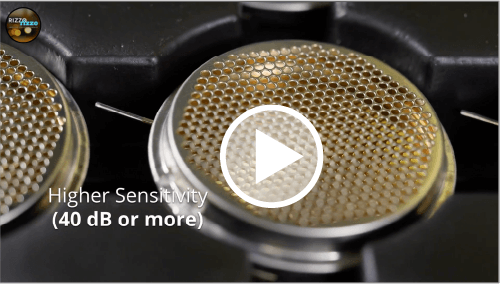
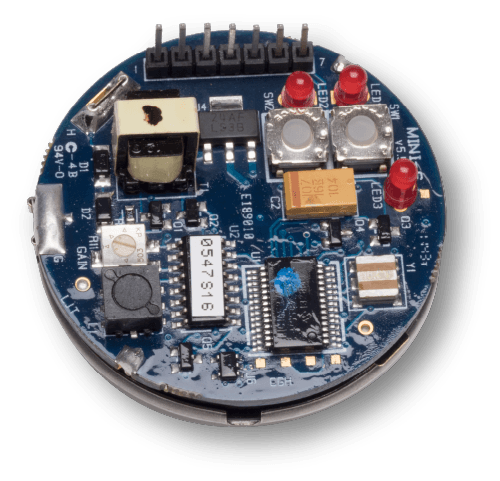
Electrostatic devices have a higher sensitivity and bandwidth than piezoelectric devices. Electrostatic devices have a relatively flat response over a wide frequency range, and because they are low-resonant, have very low ring-out characteristics. Such devices have approximately 40 dB greater receive sensitivity than piezoelectric ultrasonic transducers. The increased sensitivity translates into longer-range capabilities (or lower-gain receive circuits for shorter-range applications) and the ability to sense small and acoustically absorptive targets more reliably than piezo transducers. A single electrostatic transducer coupled with the proper electronic driver and receiver can cover a range of 1 inch to over 40 feet, making them a good choice for deep tank level measurement applications. Performance characteristics are very stable over a wide operating temperature, typically -40° to 85°C, resulting in simple drive and receive circuits that do not have to be compensated for device drift over temperature. and enables the circuitry to be packaged in the sensor housing. For example, SensComp’s electrostatic Smart Sensor measures 1.6 (dia) x 0.75 in., making it a compact solution in tight spaces.
From Polaroid Innovation to SensComp Excellence: The Exclusive Series 600 Ultrasonic Transducer
SensComp’s Series 600 Electrostatic Ultrasonic Transducer was originally developed by Polaroid in the 1970s to enable self-focusing in their cameras. When piezoelectric transducers failed to meet sensitivity requirements-especially for detecting small or soft targets – Polaroid invested millions in research and development to create a compact, low-cost electrostatic ultrasonic transducer that delivered the high sensitivity needed for precise detection at long distances.
Recognizing its broader potential beyond cameras, Polaroid’s OEM division began supplying these transducers to industries worldwide for non-contact sensing applications. In 2002, SensComp acquired this division and remains the exclusive manufacturer of the Series 600. With continuous advancements – including rugged stainless steel housings, parylene coatings, and improved gasketing – the transducer remains a reliable, high-performance solution for today’s most demanding sensing needs.

Polaroid’s breakthrough electrostatic ultrasonic transducer enabled the sale of millions of cameras worldwide.
Piezoelectric Ultrasonic Sensors: Low cost, but also low sensitivity.
Piezoelectric ultrasonic transducers are constructed using a ceramic element that has been cut and tuned to a specific frequency range. Two electrodes are then bonded to the crystal, and the crystal is then adhered inside a closed or open face housing and sealed from the rear.
The obvious advantage of piezoelectric ultrasonic transducers is the ceramic element can be placed in a variety of housings: aluminum, stainless steel, Teflon, PVC or RTV, to name a few. This allows the design engineer to choose a transducer housing that is compatible with the target being sensed and its associated environment.
The primary disadvantages of piezoelectric transducers are low sensitivity, resulting in relatively short range; long ring-out after transmit, limiting short-range detection; and resonant frequency drift with temperature. Sensor designers have successfully limited the frequency drift problem by using unique drive and receive circuit designs.
By impulse driving rather than tone driving the transducer with a high voltage, short duration and single cycle, the transducer resonates in a manner analogous to striking a bell with a hammer. The receive circuit is designed with a wider bandpass filter to accept the dynamic range of frequencies that are possible for the transducer over the specified temperature ranges.
The disadvantages of this method are limited drive power and shorter operating range. For applications where the sensor is at a constant temperature (such as indoor applications), tone driving the transducer and using a narrower receive bandpass filter provides better range performance than impulse drive methods.
Long ring-out remains a problem with piezoelectric ultrasonic transducers, and designers usually use two transducers, one to transmit and one to receive if they desire shorter range ability. Low sensitivity also limits the long-range ability of piezo-based transducers, although by modifying the transducer design and using lower-noise/higher-gain receive circuits, many manufacturers have improved the long-range capability of these transducers.
Comparing Electrostatic Ultrasonic Sensors to Piezoelectric Sensors
|
Feature |
Electrostatic Ultrasonic Sensor |
Piezoelectric Ultrasonic Sensor |
|---|---|---|
|
Transduction method |
Electrostatic (capacitive) |
Piezoelectric (crystal deformation) |
|
Frequency stability |
Very stable |
Stable, but can drift with temperature |
|
Power requirement |
High drive voltage, low current |
Moderate voltage, higher current |
|
Range |
Up to 40 feet |
Typically shorter |
|
Durability |
Excellent |
Very good |
The Benefits of Electrostatic Sensor Technology
Long range capability
Sense small targets reliably
More stable and better performance over a wide temperature range