
Reliable non-contact sensing for robotic systems and automated material handling
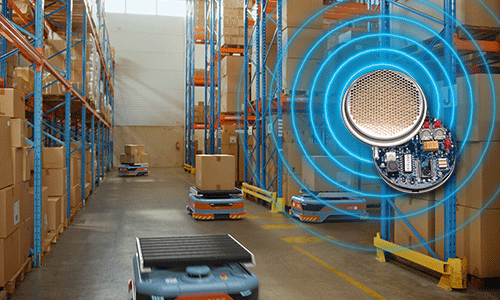
Ultrasonic sensors for AGVs and robotics operate among targets that are hard to sense reliably: people in dark or loose clothing, stretch-wrapped pallets, corrugate, foam, glass partitions, polished stainless, and long open aisles with little to reference. Optical sensors respond to a surface’s color, gloss, and reflectivity, and piezoelectric ultrasonic sensors often lose the faint return from soft or off-axis targets. SensComp’s electrostatic ultrasonic sensors have approximately 40 dB greater receive sensitivity than piezoelectric ultrasonic sensors, enabling them to resolve weak echoes from absorptive targets. With the appropriate drive electronics, they measure distances from 1 inch to more than 40 feet while maintaining frequency and gain stability from -40°C to +85°C—from cold-storage aisles to hot loading docks.
Some of the ways electrostatic ultrasonic sensing supports AGVs and robotics:
- AGV & AMR navigation
- Obstacle detection
- Collision avoidance
- Machine positioning
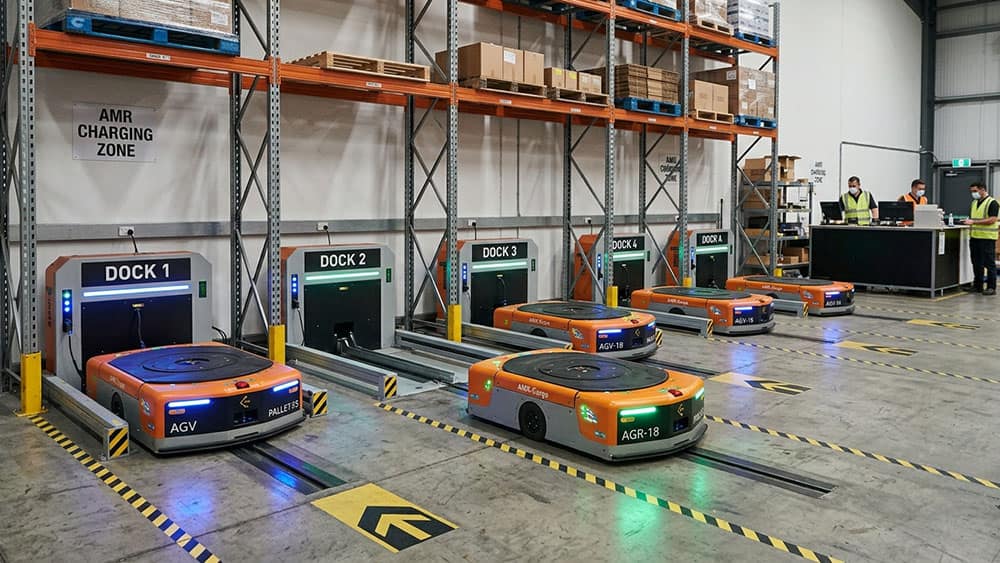
- Docking & charging station alignment

AGV & AMR navigation
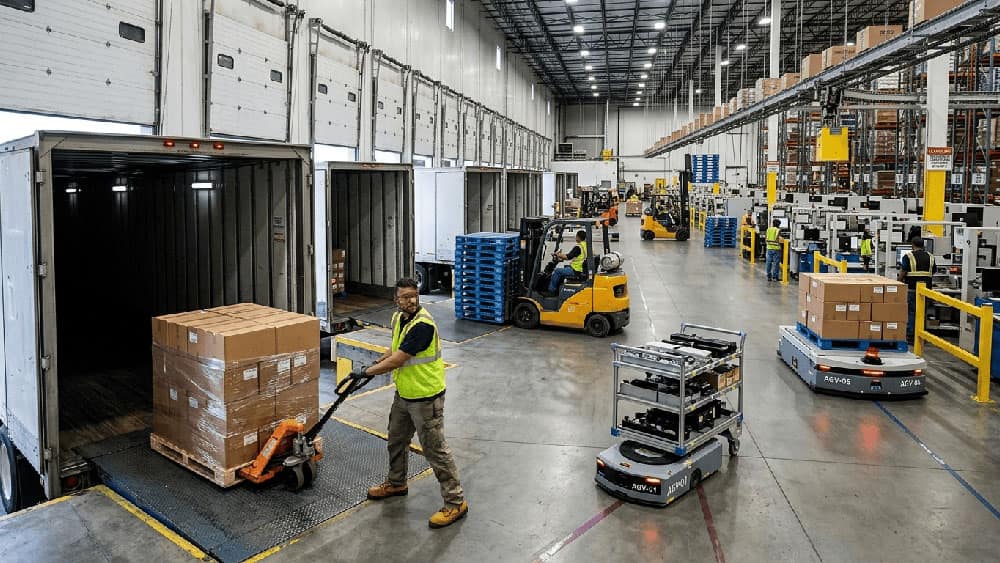
Navigation sensors have to work against whatever an aisle is made of — painted block, glass, polished stainless, or matte black racking. Optical sensors respond differently to each, and transparent or low-reflectance surfaces are where they struggle. Ultrasonic sensors measure time of flight, so surface color and ambient light barely matter.
SensComp electrostatic ultrasonic sensors have approximately 40 dB greater receive sensitivity than piezoelectric ultrasonic sensors, enabling longer standoff distances and catching weak, off-axis echoes. A 15 degree beam angle keeps the reading tied to the surface a vehicle is referencing rather than picking up adjacent racking or passing traffic.
Obstacle detection
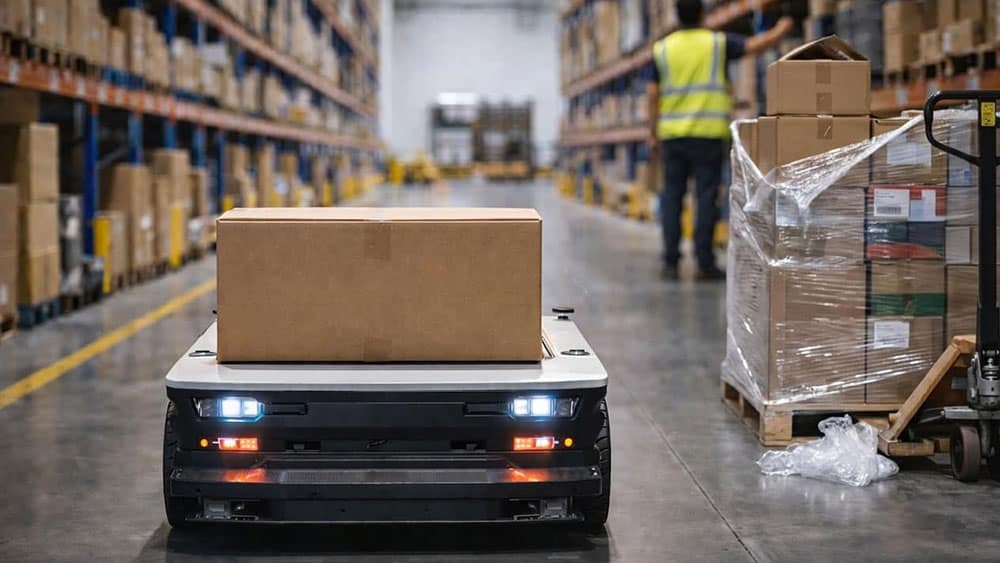
The obstacles that matter most on a plant floor are often the ones that reflect the least. A person in dark, loose clothing, a foam-wrapped fixture, a stack of corrugated cardboard, or a pallet under stretch film absorbs and scatters much of the acoustic pulse, so what comes back is faint rather than absent.
Detection comes down to receive sensitivity. SensComp’s electrostatic ultrasonic sensors have approximately 40 dB greater receive sensitivity than piezoelectric ultrasonic sensors, allowing them to resolve those weak returns instead of reading the aisle as clear. Because detection doesn’t depend on light, the same performance holds in an unlit aisle and under direct high-bay lighting.
Collision avoidance
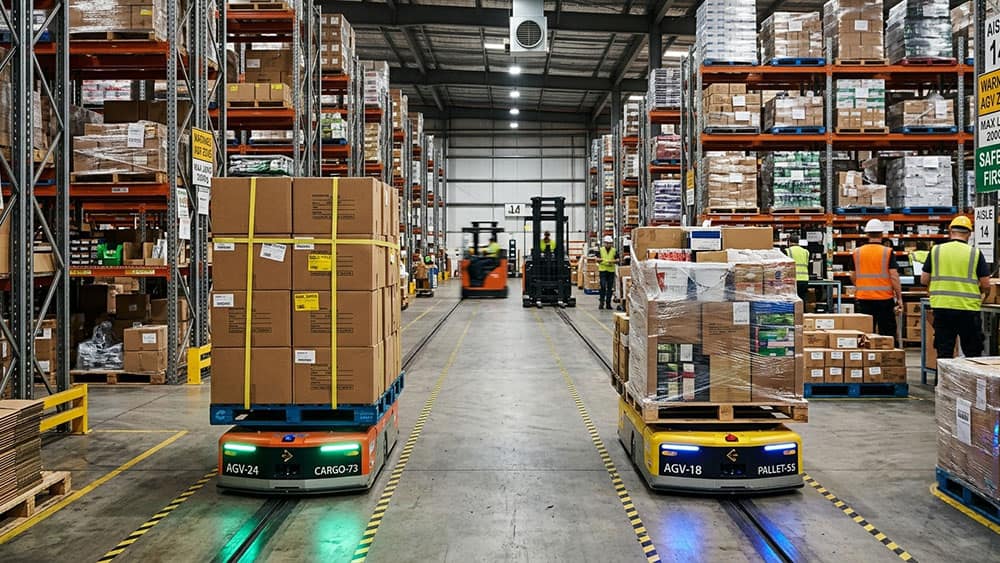
As soon as more than one vehicle runs the same route, each sensor has to tell its own echo from a neighbor’s pulse. Crosstalk shows up as phantom obstacles and unnecessary stops, and the denser the fleet, the more often it happens. Every phantom stop costs cycle time across the whole route, and the cost compounds.
SensComp’s electrostatic ultrasonic transducers are broadband — roughly 20 kHz to 100 kHz — which supports stepped multifrequency operation, so a vehicle can transmit and listen on a frequency its neighbors aren’t using. Piezoelectric ultrasonic transducers are tied to a narrow band around one resonant frequency, leaving far less room to separate one vehicle from another.
Machine positioning
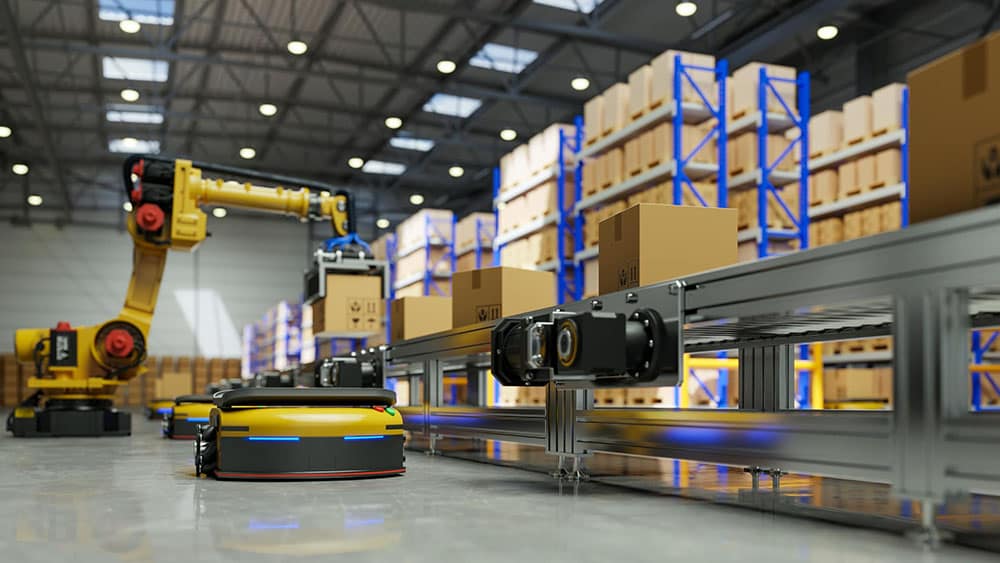
Positioning tasks, like squaring a robot to a fixture, stopping a lift at a set height, or maintaining a gap between a machine and a conveyor, depend on distance measurements that stay consistent from the start of a shift to the end. Piezoelectric ultrasonic transducers can drift in frequency and gain as temperatures change.
SensComp’s electrostatic ultrasonic transducers remain frequency- and gain-stable from -40°C to +85°C, so a position taught in a cold facility still measures the same after the building warms up. Because the speed of sound in air changes with temperature regardless of transducer type, accurate absolute measurements require temperature compensation wherever ambient temperatures vary.
Docking & charging station alignment
Docking is a close-range sensing challenge. As the gap narrows to just a few inches, the vehicle must keep receiving reliable distance measurements, and a transducer’s settling time after each transmit pulse determines the size of its near-field blind zone. A long blind zone forces a handoff at the worst moment.
SensComp’s electrostatic ultrasonic transducers use a low-resonance membrane that settles quickly after transmission, giving a short blind zone and a usable range from approximately 1 inch to more than 40 feet with appropriate drive electronics. That range lets a single transducer guide the approach from across the facility into the docking position, with no handoff to a second sensor.

Additional Resources
ARTICLE
Ultrasonic Sensor Performance Characteristics for AGV and AMR Applications ➔

Ultrasonic Sensors for AGVs and Robotics: FAQs
Optical sensors depend on how a surface reflects light, and common warehouse materials — glass, polished metal, matte black finishes, and clear film — can reduce their effectiveness. Ultrasonic sensors measure the time of flight of an acoustic pulse, making them largely unaffected by surface color, gloss, or ambient light. SensComp’s electrostatic ultrasonic sensors have approximately 40 dB greater receive sensitivity than piezoelectric ultrasonic sensors, allowing them to detect weak echoes from soft, absorptive obstacles.
Rather than replacing LiDAR or cameras, ultrasonic sensing provides a complementary layer that performs well where optical sensing is most challenged.
Often, yes — as long as the sensor can resolve weak echoes. Clothing, foam, corrugated cardboard, and stretch film absorb and scatter sound, producing echoes that are faint rather than absent. SensComp’s electrostatic ultrasonic sensors have approximately 40 dB greater receive sensitivity than piezoelectric ultrasonic sensors, improving detection of these low-reflectivity targets.
Ultrasonic sensing is intended as a functional sensing layer, not a replacement for certified safety sensors required for safety-rated stop functions.
Interference can be managed by separating vehicles in frequency, time, or both. SensComp’s electrostatic ultrasonic transducers operate across a broad frequency range of approximately 20 kHz to 100 kHz, allowing each vehicle to use a unique drive frequency and recognize only its own signal.
Piezoelectric ultrasonic transducers operate over a much narrower frequency range, making time-based sequencing the primary method for reducing interference. In dense fleets, frequency separation and timing can be combined.
The minimum measurement distance is determined by the near-field blind zone — the brief period after transmission when the transducer is still ringing and cannot receive echoes. SensComp’s electrostatic ultrasonic transducers use a low-resonance membrane that settles quickly after each transmit pulse, supporting measurements from approximately 1 inch with appropriate drive electronics.
That short blind zone allows a single transducer to guide both the approach and final docking alignment.
Yes. SensComp’s electrostatic ultrasonic transducers remain frequency- and gain-stable from -40°C to +85°C, supporting reliable operation from freezer aisles to hot loading docks without recalibration.
Because the speed of sound changes with air temperature, accurate absolute distance measurements still require temperature compensation whenever ambient temperatures vary.
For wash-down or condensing environments, Environmental Grade construction adds 304 stainless steel and an optional parylene conformal coating, with minimal dampening of acoustic sensitivity.
Often, yes. The deciding factors are beam pattern and application requirements rather than measurement range alone. A single SensComp electrostatic ultrasonic sensor measures from approximately 1 inch to more than 40 feet with appropriate drive electronics, making it suitable for both close-range obstacle detection and longer-range wall referencing.