
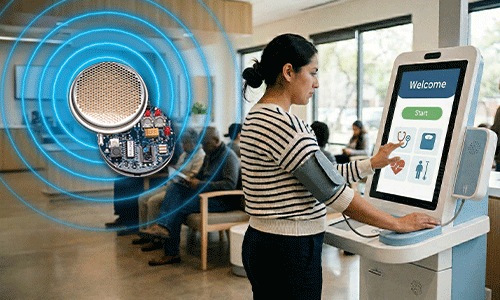
Self-service health screening kiosks are showing up in pharmacies, employer wellness centers, urgent care lobbies, and telehealth stations. They measure blood pressure, weight, BMI, temperature, and other vitals without requiring a staff member to operate them. The concept works — until the kiosk can’t tell whether someone is actually standing in front of it.
Patient presence detection is the trigger for everything else the kiosk does. It wakes the system, initiates the screening workflow, adjusts for the patient’s height and distance, and determines when the session is over. If that detection is unreliable, the downstream experience falls apart: screens activate with nobody there, sessions time out while a patient is still being measured, or the system fails to start entirely and the patient walks away.
This blog looks at why ultrasonic sensing — specifically SensComp’s electrostatic ultrasonic technology — is well suited for this application, and what design engineers should consider when integrating presence detection into kiosk platforms.
Why Presence Detection at Kiosks Is Harder Than It Looks
At first glance, detecting whether a person is standing in front of a kiosk seems simple. In practice, it’s a surprisingly difficult sensing problem.
People are soft, acoustically absorptive targets. Clothing, hair, and skin don’t reflect sound the way metal or plastic does. A patient in a puffy winter coat returns a very different echo than someone in a thin t-shirt. A child standing at the edge of the detection zone looks nothing like an adult positioned directly in front of the sensor.
Optical sensors can struggle with varying skin tones, ambient lighting changes, and privacy concerns around camera-based detection in healthcare settings. Infrared sensors can be affected by body temperature blending with warm ambient environments. Capacitive and pressure-based solutions require physical contact or specific positioning that limits kiosk placement flexibility.
Ultrasonic sensing avoids most of these issues. It’s non-contact, works regardless of lighting or skin tone, and doesn’t raise the same privacy concerns as camera-based systems. But standard piezoelectric ultrasonic sensors introduce their own problems — limited sensitivity on soft targets like clothing, dead zones at close range from ring-out, and frequency drift in environments where the temperature isn’t tightly controlled.
How Electrostatic Ultrasonic Sensors Solve the Problem of Presence Detection at Self-Service Health Screening Kiosks
SensComp’s electrostatic ultrasonic transducers address the specific challenges that kiosk presence detection presents.
Detecting people, not just objects: With approximately 40 dB greater receive sensitivity than piezoelectric ultrasonic transducers, electrostatic ultrasonic transducers reliably detect the faint echoes that come back from soft, sound-absorbing surfaces like clothing and skin. The sensor doesn’t need a hard, flat target to get a clean return — it works on people as they actually present themselves, regardless of what they’re wearing or how they’re standing.
Close-range accuracy: Kiosk interactions happen at short distances — typically a few inches to a few feet. Piezoelectric ultrasonic sensors’ ring-out can create a dead zone that covers exactly this range. Electrostatic transducers are low-resonant with minimal ring-out, enabling reliable detection starting from as close as 1 inch. That means the sensor can tell the difference between a patient stepping up to the kiosk and one who has walked away, without a gap in coverage right where it matters.
Height and distance measurement: Beyond simple presence or absence, electrostatic sensors can provide continuous distance data accurate to ±1/8 inch within 10 feet. This allows the kiosk to determine patient height, adjust screen positioning or camera angle for telehealth consultations, and verify that the patient is in the correct position for an accurate blood pressure or temperature reading.
Stable performance without recalibration: Health kiosks get deployed in pharmacies with air conditioning, outdoor wellness stations, and hospital lobbies near automatic doors. Temperature can swing significantly throughout the day. Electrostatic transducers maintain stable frequency and gain from -40°C to +85°C, so the presence detection threshold doesn’t drift between a cold morning startup and a warm afternoon.
Design Considerations for Kiosk Integration
Engineers integrating electrostatic ultrasonic presence detection into kiosk platforms should keep these points in mind:
Sensor placement: Mount the transducer at a height and angle that captures the broadest range of patient sizes. A downward-angled mount near the top of the kiosk can detect both an adult’s torso and a child’s head, while avoiding false triggers from people walking past at the periphery of the beam.
Beam angle selection: The SensComp Series 600 transducer’s 15-degree beam provides focused detection well suited to kiosk applications where you want to sense the person directly in front of the unit without picking up adjacent foot traffic. For wider coverage, the SensComp Series 7000’s 17-degree beam in a smaller housing may be a better option for compact kiosk designs.
Session management logic: Use continuous distance data to manage session states — detect approach, confirm presence at the interaction zone, monitor for the patient stepping away mid-session, and confirm departure to reset the kiosk. This is more robust than a simple binary present/not-present trigger.
Compact form factor: The SensComp Smart Sensor packages the transducer and drive electronics into a unit measuring 1.6 inches in diameter by 0.75 inches deep. For kiosk enclosures where space is tight, this eliminates the need to design custom driver boards and simplifies the mechanical integration.
Privacy by design: Ultrasonic presence detection collects no visual data. There’s no camera feed to secure, no facial recognition data to store, and no video stream to encrypt. For healthcare applications subject to patient privacy regulations, this is a significant advantage over optical sensing approaches.
The Right Sensor for the Interaction
Health screening kiosks need presence detection that works on real people in real environments — not just on ideal targets under controlled conditions. SensComp’s electrostatic ultrasonic sensors and transducers deliver the sensitivity, close-range accuracy, and environmental stability that this application demands, in a compact, privacy-friendly package.
For help integrating patient presence detection into your kiosk platform, contact our engineering team or explore our product options:
https://www.senscomp.com/contact/?utm_source=linkedin&utm_medium=social&utm_campaign=linkedin_may26