

How electrostatic ultrasonic sensing turns distance readings into stockpile volume estimates — aiming at the peak, treating lost echoes off steep flanks as missing data, and matching a geometry model to how each pile is built.
Key answers at a glance
Can ultrasonic sensors measure stockpile volume? Indirectly. They measure distance to the pile surface, which gives surface height, and a geometry model based on the pile shape and angle of repose converts that height into volume.
Where should the sensor aim? At the peak. The peak presents an area parallel to the transducer face, which returns the strongest available signal. A highly angled flank deflects the signal away from any ultrasonic sensor.
Why does a sensor read empty over a full pile? The return off the peak is small and soft, and a piezoelectric ultrasonic sensor may miss it. Electrostatic ultrasonic transducers have approximately 40 dB greater receive sensitivity than piezoelectric ultrasonic transducers, which gives them the sensitivity to detect that faint echo.
How accurate is the volume estimate? It depends mostly on the geometry model. For a conical pile, a 1% height error becomes roughly a 3% volume error, and a two-degree error in the assumed angle of repose can shift the estimate by about 16%.
Will it work in an unheated dome or shed? Yes, with the right configuration. The bare 600 Series electrostatic ultrasonic transducer holds frequency and gain from -40°C to +85°C, paired with drive electronics rated for the site, while the 6500 Series Ranging Module and Smart Sensor are rated 0°C to +70°C.
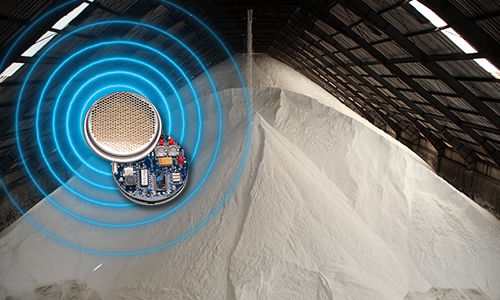
A stockpile inventory figure starts as a distance reading and ends as cubic yards or tons, and most of the error enters between those two points. This note covers conical piles under conveyors and stackers, covered bays and storage sheds, and salt and sand domes.
How do ultrasonic sensors measure stockpile volume?
Ultrasonic sensors don’t measure volume directly. A sensor mounted above the pile times the echo from the pile surface, the controller converts that time into distance, and subtracting the distance from the mounting height gives the surface height at that point. A geometry model based on the pile’s shape and its angle of repose then converts one or more height readings into volume.
That last step carries most of the uncertainty. One peak reading can define a free-standing cone, because its flanks follow the angle of repose. A pile pushed into a bay, reworked by a loader, or built past its discharge point needs more readings and a different model.
Moving equipment is covered in SensComp’s load and material-height application note, and enclosed bins and tanks in its grain bin and tank blog.
Why is estimating stockpile volume from distance harder than it looks?
Because most of a stockpile’s surface can’t be measured from above. Material settles at its angle of repose, so the flanks are steep surfaces that deflect an ultrasonic pulse away from the transducer. The peak and any flat top return usable echoes, and the volume calculation depends on assumptions about everything else.
- Steep flanks. A steeply angled surface deflects the pulse away from the transducer, so flanks are best handled by sensor placement, not sensor choice. Aim at the peak and top, and let the angle of repose define the sides, or add sensors across wider piles.
- A small, soft peak. The top of a cone presents only a small area parallel to the transducer face, and granular material returns a weak echo. A piezoelectric ultrasonic sensor may miss it, and the pile reads empty.
- Piles that stop growing taller. Once a cone reaches the discharge point, material spills outward and the top flattens, and loader rework reshapes piles further. Height stops rising while volume keeps climbing, so a height-only cone model starts undercounting.
- The falling stream. While a conveyor runs, the stream of material and the dust around it sit between the sensor and the pile, and either can return an echo first.
- Air temperature. The speed of sound changes with air temperature, and unheated domes and sheds can swing widely between seasons.
- Lost echoes that look like data. When no echo clears the detection threshold, most systems report maximum range or hold the last valid value. Either output can pass for a real reading, so a flank or a missed peak can show up as an empty pile.
Where should ultrasonic sensors be mounted over a stockpile?
Aim at the top of the cone that represents peak fill, offset far enough that the beam isn’t looking into the falling stream while material is being added. The peak presents an area parallel to the transducer face, the optimum geometry for the strongest available return signal, while aiming at a flank returns nothing usable.
Keep the standoff within range at every fill level
The distance that matters runs from the transducer to the lowest surface it must read, usually the floor when the pile is empty. A single electrostatic ultrasonic transducer covers 1 inch to over 40 feet with appropriate drive electronics, but a packaged module carries its own rated range. In a tall dome, that can mean mounting off the conveyor structure below the apex.
Plan the beam footprint
The 15 degree beam angle of an electrostatic ultrasonic transducer helps capture weak and off-axis echoes. Nominally, the footprint on the pile is about a quarter of the standoff distance across, or roughly 5 feet at a 20-foot standoff. Most ranging electronics report the first echo that clears the detection threshold, so the reading is the nearest reflecting surface inside that footprint, not an average of it.
Keep it clear of bay walls, roof trusses, and conveyor structure at every fill level.
Measure between fills
Take readings with the conveyor stopped and give airborne dust time to settle, or gate readings on the conveyor’s run signal. That keeps the falling stream out of the measurement and lets the controller average several pulses on a stable surface.
Account for the near field as the pile grows
On a conveyor or dome cone, the peak climbs toward a sensor mounted near the discharge point, so the last part of the fill happens closest to the transducer. A piezoelectric ultrasonic transducer rings after transmit, masking echoes inside roughly 13 to 14 inches or more. Electrostatic ultrasonic transducers use a low-resonance membrane that settles quickly, so with appropriate drive electronics they keep reading to within 1 inch of the face.
A packaged module carries its own rated minimum range, so check its datasheet rather than assuming the transducer figure.
How much of a stockpile’s surface can ultrasonic sensors actually measure?
Only the surfaces that face the sensor: the peak, flat or leveled tops, and exposed floor. Flanks at the angle of repose deflect the pulse away from any ultrasonic sensor, so their shape has to come from a geometry model rather than a measurement. Every other reading is missing data, not an empty pile.
Treat a lost echo as missing, not empty
A maximum-range reading over a pile that was loaded an hour ago is far more likely to be a lost echo than an empty floor. Reject readings that drop faster than material could be removed, hold the last valid value with a flag, and check any drop against loadout records.
Add sensors where the shape varies
A line of sensors along a pile built by a traveling stacker, or across a bay, can locate the ridge, the extent of a flat top, and exposed floor. Each added sensor narrows what the model has to assume.
In covered bays and storage sheds, sensors along the bay centerline often read the top of material pushed against the back wall and the floor near the open front, with the loader-built face between them left to the model.
Fire multiple sensors in sequence
Adjacent sensors can hear each other’s pulses. Triggering them one at a time from the controller, through the INIT input on the 6500 Series Ranging Module or the external trigger input on the Mini-A, keeps each echo attributable to the sensor that sent it.
How do you convert measured heights into a volume estimate?
| Pile shape | Where it forms | What the sensors measure | Volume model | Error Sensitivity |
|---|---|---|---|---|
| Conical pile | Fixed conveyor or stacker discharge; dome fill point | Peak height h | V = πh³ / (3 tan²θ) | Height error roughly tripled; θ error enters through tan²θ |
| Elongated pile | Traveling stacker or shuttle conveyor | Ridge height h along ridge length L | V = Lh² / tan θ + πh³ / (3 tan²θ) | Height error roughly doubled to tripled |
| Pile against a bay back wall | Loader-pushed bays in sheds and plants | Height h at the back wall; bay width W | V = Wh² / (2 tan θ), while the toe stays inside the bay | Height error roughly doubled; θ error enters through tan θ |
| Flat-topped pile | Cone that has reached its discharge height, or a leveled pile | Top height h; flat-top radius a from a line of sensors | V = (πh / 3)(R² + Ra + a²), where R = a + h / tan θ | Set largely by how well the flat top is located |
Calibrate the angle of repose on site
Published angle-of-repose values are a starting point, not a site constant. Moisture, gradation, and how material is placed, whether dropped from a conveyor or pushed by a loader, all change it. Survey periodically, back-calculate the angle that makes the model match, and recheck it seasonally, since damp or frozen material can stand steeper.
Compensate the distance reading for temperature
The speed of sound in air varies with temperature, so compensation is a requirement in unheated domes and sheds, not an optional refinement. A co-located temperature sensor corrects for air at the transducer; in a tall structure where roof air runs warmer, a reading against a fixed reference distance can help correct for the whole path.
Which ultrasonic sensor characteristics matter for stockpile measurement?
Receive sensitivity, close-in capability, and temperature stability matter most, because the target is a small, soft peak, the pile grows toward the sensor, and domes and sheds are often unheated. Electrostatic ultrasonic transducers have approximately 40 dB greater receive sensitivity than piezoelectric ultrasonic transducers, which gives them the sensitivity to detect the faint return off a pile peak. Flanks limit both technologies equally.
| Factor | Electrostatic Ultrasonic (SensComp) | Piezoelectric Ultrasonic |
| Return off a small, soft pile peak | Approximately 40 dB greater receive sensitivity than piezoelectric ultrasonic transducers, enough to detect the faint echo | May miss the faint echo, so the system reports maximum range and the pile reads empty |
| Steep flanks at the angle of repose | Signal deflects away; model the flanks | Signal deflects away; model the flanks |
| Near field as the pile reaches the sensor | Low-resonance membrane settles quickly; with appropriate drive electronics, reads to within 1 inch of the face | Rings after transmit, masking echoes inside roughly 13 to 14 inches or more |
| Temperature | Bare transducer holds frequency and gain from -40°C to +85°C; air-path compensation still required | Air-path compensation required; confirm transducer stability across the site range |
| Airborne dust | Not blinded by dust; receive sensitivity adds headroom when dense dust attenuates the return | Not blinded by dust; dense dust attenuates the return |
| Range | 1 inch to over 40 feet with appropriate drive electronics | Varies by device; confirm rated range against the standoff to the floor |
| Beam angle | 15 degrees | Varies by device |
Dust from aggregate, sand, and salt handling doesn’t blind ultrasonic sensing the way it blinds optical sensing, and that applies to ultrasonic sensing broadly. The receive sensitivity of electrostatic ultrasonic transducers adds headroom when dense dust attenuates the return.
What should you specify, and where does ultrasonic stop being the right tool?
Specify by temperature first, then by how the controller wants the data. In unheated domes and sheds that drop below freezing, use the bare 600 Series electrostatic ultrasonic transducer, which holds frequency and gain from -40°C to +85°C, with drive electronics rated for the site. Where the installation stays within 0°C to +70°C, the 6500 Series Ranging Module and Smart Sensor supply the drive electronics.
Match the output to the controller
The 6500 Series Ranging Module and Smart Sensor output an echo edge for the controller to time, which suits sequencing several sensors. For a direct PLC connection, the Mini-A has a 0 to 5 VDC or 0 to 10 VDC analog output, and the Mini-S has two switchpoint outputs for high and low alarms. Check the Mini Series datasheet rating against the site’s temperature range.
Protect the transducer for the environment
Salt domes and aggregate sheds combine corrosive or abrasive dust with humidity. SensComp offers Environmental Grade transducers in 304 stainless steel, with parylene conformal coating available as an option that blocks moisture and harsh chemicals with minimal dampening of acoustic sensitivity.
Enclosures are customer-built, and an open-cell acoustical foam filter can be added in front of the transducer face. Include the transducer face in routine inspection for settled material.
Know where ultrasonic stops fitting
Overhead ultrasonic sensors fit piles with a repeatable shape and a standoff within range. Large open-yard stockpiles, piles reshaped every shift, and survey-grade inventory reconciliation call for scanning laser or drone photogrammetry, with ultrasonic sensors tracking day-to-day change between surveys.
Frequently Asked Questions
It depends more on the geometry model than on the distance reading. For a conical pile, volume scales with the cube of height, so a 1% height error becomes roughly a 3% volume error, and assuming 35 degrees instead of 37 degrees for the angle of repose shifts the estimate by about 16%. Electrostatic ultrasonic transducers with temperature compensation address the height side, and a site survey calibrates the angle of repose.
Often, yes, if the pile is a free-standing cone under a fixed discharge point. An electrostatic ultrasonic transducer aimed at the top of the cone that represents peak fill measures peak height, and the flanks follow the material’s angle of repose, so one reading defines the pile. Once the cone flattens at its discharge height or a loader reworks it, additional sensors are needed.
Usually because the echo off the peak is too weak to register. The top of a pile is small and soft, and a piezoelectric ultrasonic sensor may miss the return, so the system reports maximum range and the pile reads empty. Electrostatic ultrasonic transducers have approximately 40 dB greater receive sensitivity than piezoelectric ultrasonic transducers, which gives them the sensitivity to detect that faint echo.
Yes. Unlike optical sensors, ultrasonic sensors aren’t blinded by airborne dust, and electrostatic ultrasonic transducers have approximately 40 dB greater receive sensitivity than piezoelectric ultrasonic transducers, which adds headroom when dense dust attenuates the return. Readings are most reliable with the conveyor stopped and dust settled.
Yes, with the right configuration. The bare 600 Series electrostatic ultrasonic transducer holds frequency and gain from -40°C to +85°C, paired with drive electronics rated for the site. The 6500 Series Ranging Module and Smart Sensor are rated 0°C to +70°C, so they fit installations that stay above freezing. Either way, the controller needs temperature compensation for the air path.
The limit is the standoff to the lowest surface the sensor must read, usually the floor when the pile is empty, not the height of the pile. A single electrostatic ultrasonic transducer can be configured to cover 1 inch to over 40 feet, and a packaged module carries its own rated range.
Multiply the volume estimate by the bulk density of the material as it sits in the pile. Bulk density varies with moisture, gradation, and compaction, so use a density measured from the site’s own material and reconcile the result against scale tickets rather than a handbook value.
Not for every pile. Overhead electrostatic ultrasonic transducers track piles with a repeatable shape continuously, while drone photogrammetry and scanning laser capture the full surface, including flanks that deflect an ultrasonic pulse. A practical pairing uses ultrasonic sensors for day-to-day change at the peak and periodic surveys to calibrate the angle of repose and reconcile the inventory.