
Sensing components built for real classroom conditions.
Ultrasonic sensors for STEM education work in conditions no OEM specifies. The target is whatever a student picks up, the room is warmer at two o’clock than it was at eight, and neither is something the design can control. Soft surfaces return faint echoes, temperature drift moves a piezoelectric ultrasonic transducer off calibration, and both reach the instructor as a missed reading.
SensComp’s electrostatic ultrasonic transducers have approximately 40 dB greater receive sensitivity and hold frequency and gain steady across that swing, so the finished product returns clean data instead of warranty claims.
Some of the ways electrostatic ultrasonic sensing supports agriculture:
- Motion and distance probes
- Benchtop close-range measurement
- Whole-classroom demonstrations
- Student design and robotics projects

Motion and distance probes
Motion probes track whatever a student puts in front of them: a hand, a fabric-covered cart, a half-filled beaker. Those targets absorb sound instead of reflecting it cleanly, and a piezoelectric ultrasonic transducer often loses the return entirely, leaving a gap in a motion-versus-time plot. SensComp’s electrostatic ultrasonic transducers have approximately 40 dB greater receive sensitivity, plus a 15-degree beam that helps capture weak off-axis echoes, so the probe resolves the faint return and the plotted curve matches the physics being taught.
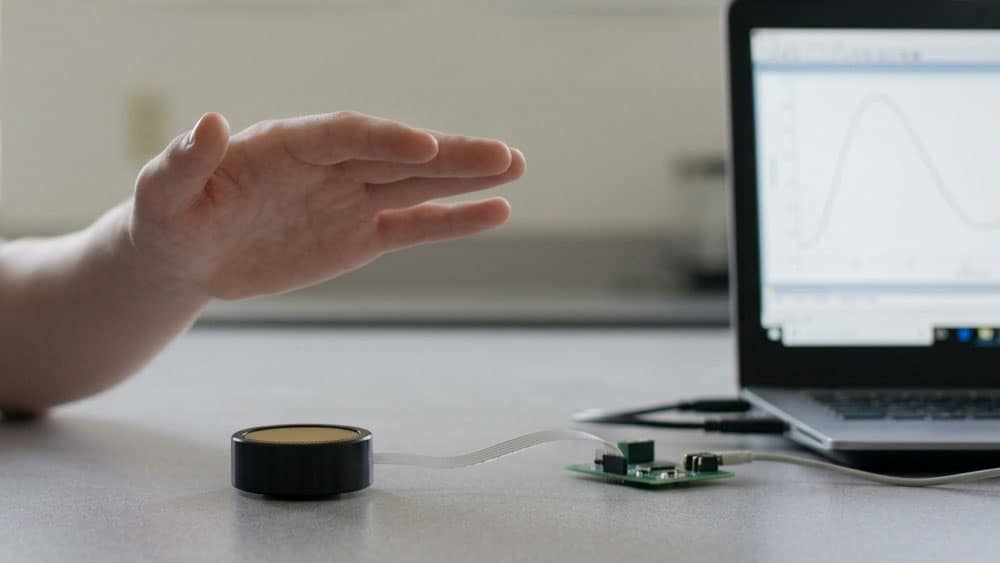
Benchtop close-range measurement
Bench experiments run in inches, not feet, and the near field is where most ultrasonic designs quit. A piezoelectric ceramic keeps ringing after it transmits, masking echoes inside roughly 13 to 14 inches or more, which puts the first foot of a lab bench out of reach. SensComp’s electrostatic ultrasonic transducers use a low-resonant membrane that settles in tenths of milliseconds, and with appropriate drive electronics the usable measurement starts within 1 inch of the face, so a cart released a hand’s width away registers on the first sample.
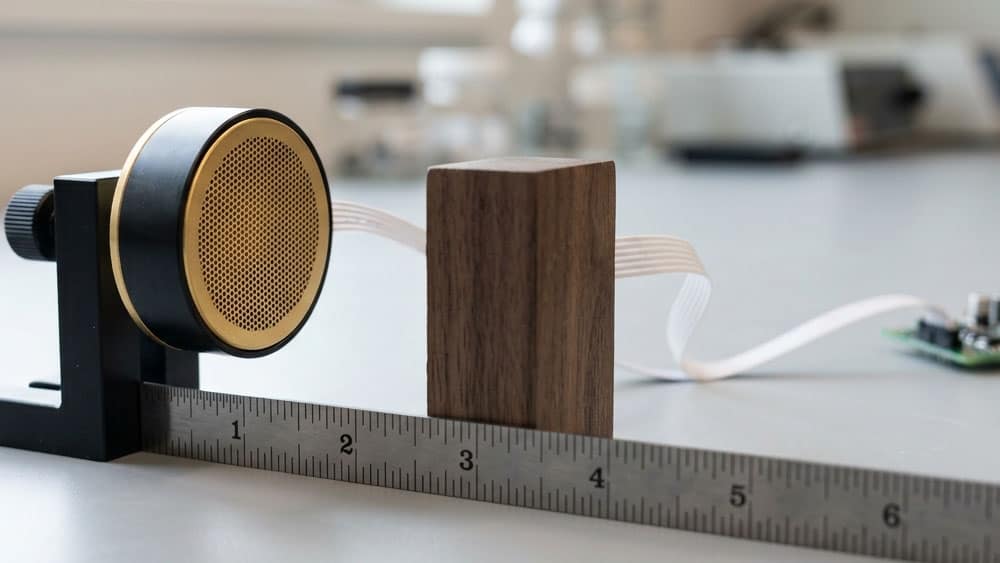
Whole-classroom demonstrations
The same product that measures a cart on a bench often has to measure a student walking to the back of the room, and most sensing designs force a hardware swap between those two jobs. A single SensComp electrostatic ultrasonic transducer covers 1 inch to over 40 feet with appropriate drive electronics, so a single part number spans the whole curriculum. For an OEM, that means one BOM, one calibration routine, and one set of spare parts across an entire product line, instead of separate short-range and long-range variants of the same instrument.
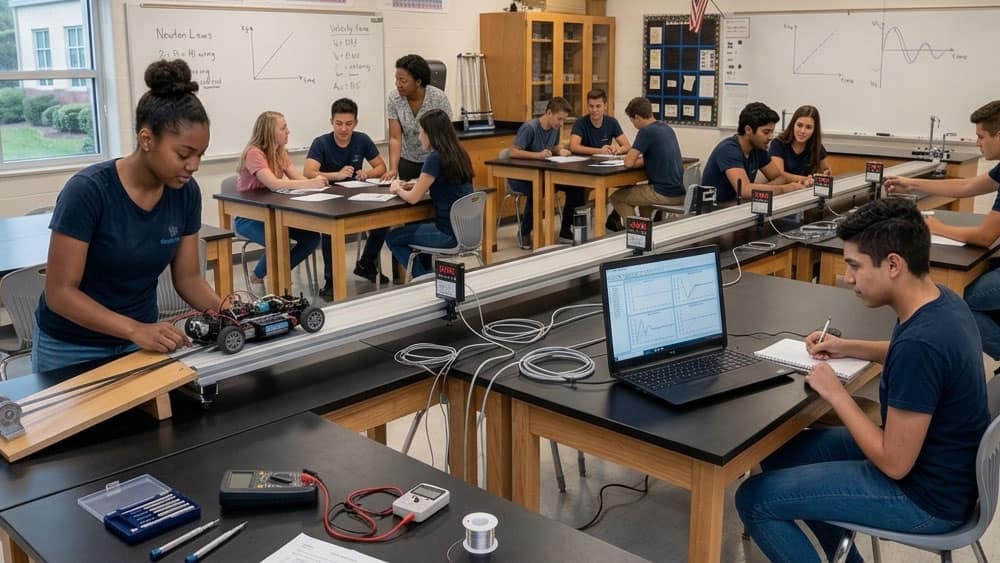
Student design and robotics projects
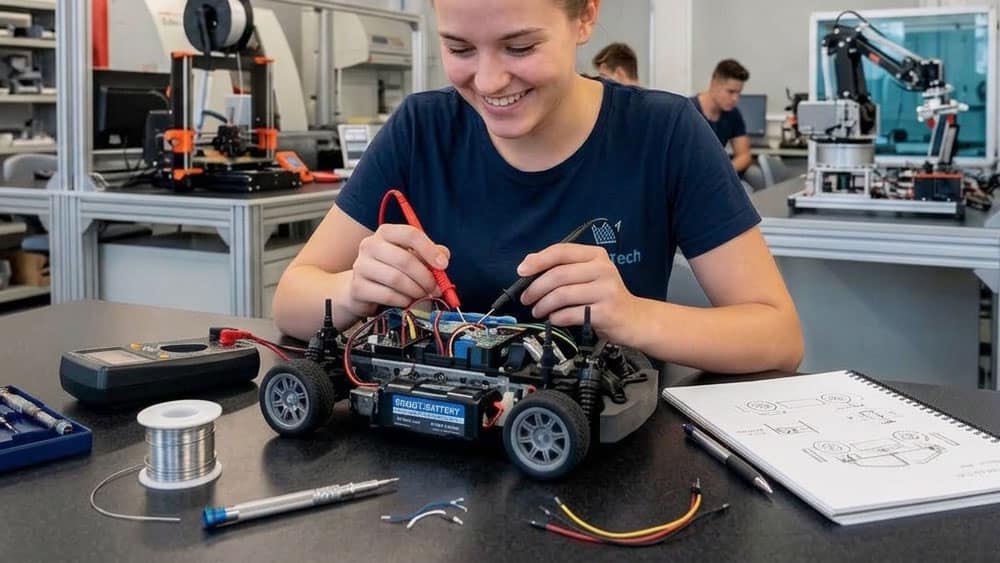
Student robots and design-competition builds run on batteries, and the sensing layer competes with the drive motors for every milliamp. SensComp’s electrostatic ultrasonic transducers draw less than 0.15 watts, which leaves useful runtime for a platform students will cycle through a full class period without reaching for a charger. The same transducer pairs with an integrated ranging module handling the drive signal, timing, and echo filtering, so a kit reaches the student as a working sensing block rather than a circuit to troubleshoot.



FAQs
Closer than most ultrasonic designs allow. A piezoelectric ceramic keeps ringing after it transmits, masking echoes inside roughly 13 to 14 inches or more, which rules out the near half of a lab bench. SensComp’s electrostatic ultrasonic transducers use a low-resonant membrane that settles in tenths of milliseconds, and with appropriate drive electronics the usable measurement starts within 1 inch of the transducer face. For an education product, that means a cart or a hand released a few inches from the probe still produces a valid first reading.
Yes. A single SensComp electrostatic ultrasonic transducer covers 1 inch to over 40 feet with appropriate drive electronics, so the same part handles a cart traveling two feet along a track and a student walking to the back of a classroom. For an OEM building a product line, that removes the usual split between a short-range probe and a long-range one: a single sensing component, a single calibration routine, and a single set of spare parts across the whole catalog.
SensComp’s electrostatic ultrasonic transducers draw less than 0.15 watts. On a battery-powered student robot or a portable data logger, where the sensing layer shares a pack with drive motors and a display, that leaves useful runtime for a full class period. Power draw should be budgeted alongside the drive electronics rather than for the transducer alone, since the ranging module and controller in a finished product each add their own load to the design.
SensComp’s electrostatic ultrasonic transducers hold frequency and gain steady from -40°C to +85°C, which is the specification for the bare transducer. In a classroom that margin is far wider than the application needs, and that is the point: the swing between a cool morning section and a warm afternoon one sits well inside it, so readings stay repeatable through the day without an instructor recalibrating between periods. A complete sensor unit carries a narrower rating than the transducer alone.
SensComp’s electrostatic ultrasonic transducers have a 15-degree beam angle, which is narrow rather than wide. The detection advantage comes from receive sensitivity, not from covering more area: the 15-degree pattern helps capture weak and off-axis echoes that a less sensitive transducer would miss. For a product designer, that means aiming and mounting matter. Point the transducer down the axis of travel for a motion study, and keep the intended target inside the beam rather than relying on spread.