
SensComp News

Give your skiers accurate snow depth

How to Accurately Measure Snow Height with Electrostatic Ultrasonic Sensors 

What Is Ultrasonic Snow Depth Measurement? Electrostatic ultrasonic sensors measure snow height by emitting a 40 kHz acoustic pulse downward toward the ground, detecting the return echo from the air–snow interface, and converting the round-trip travel time into a distance measurement. Snow depth is then calculated by subtracting that measured distance from the known reference […]

How to Accurately Measure Snow Height with Electrostatic Ultrasonic Sensors  Read Post »

Applications Where Electrostatic Ultrasonic Sensors Outperform Piezoelectric Sensors

Electrostatic ultrasonic sensors and transducers deliver performance advantages that piezoelectric sensors cannot match—particularly in applications that require long range, soft-target detection, small-object recognition, or stable operation across temperature changes. By leveraging a lightweight electrostatic membrane rather than a heavy ceramic disk, these sensors achieve up to 40 dB higher sensitivity, and maintain consistent performance in conditions

Applications Where Electrostatic Ultrasonic Sensors Outperform Piezoelectric Sensors Read Post »

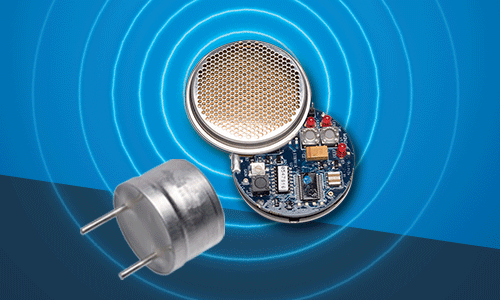
Image of a SensComp electrostatic ultrasonic sensor next to a piezoelectric ultrasonic sensor.

Electrostatic Ultrasonic Sensors vs. Piezo Sensors: Which One is Better for My Application?

When most engineers think about in-air ultrasonic sensing, they picture a cheap, ceramic “hockey puck” — a piezoelectric transducer. But piezo is not the only option, and not always the right choice. Electrostatic ultrasonic sensors use a different transduction mechanism that delivers higher sensitivity, wider bandwidth, and more stable performance in demanding in-air applications. How

Electrostatic Ultrasonic Sensors vs. Piezo Sensors: Which One is Better for My Application? Read Post »

Benefits of SensComp Electrostatic Transducers

Electrostatic devices have a higher sensitivity and bandwidth than piezoelectric devices. Electrostatic devices have a relatively flat response over a wide frequency range, and because they are non-resonant, have very low ring-out characteristics. Such devices are more sensitive than their piezo counterparts, typically by 40 dB or better. The increased sensitivity translates into longer-range capabilities

Benefits of SensComp Electrostatic Transducers Read Post »

Shopping Cart
Scroll to Top